Saturday, June 22, 2019

When was dslr invented

Hello friends and viewers, this blog is about the history of DSLR. These are the first DSLR manufactured. Full form of DSLR is Digit Single Lens Reflector. 
Kodak DCS 100, based on a Nikon F3 body with Digital Storage Unit, released in May 1991
Nikon NASA F4 back view with Electronics Box, launched on STS-48September 1991
Now, we are talk about the invention. In 1969 Willard S. Boyle and George E. Smith invented the first successful imaging technology using a digital sensor, a CCD (Charge-Coupled Device). CCD would allow the rapid development of digital photography. For their contribution to digital photography Boyle and Smith were awarded the Nobel Prize for Physics in 2009.
In 1975 Kodak engineer Steven Sasson invented the first digital still camera, which used a Fairchild100×100 pixel CCD.
On August 25, 1981 Sony unveiled a prototype of the Sony Mavica. This camera was an analog electronic camera that featured interchangeable lenses and a SLR viewfinder.
In 1986, the Kodak Microelectronics Technology Division developed a 1.3 MP CCD image sensor, the first with more than 1 million pixels. In 1987, this sensor was integrated with a Canon F-1 film SLR body at the Kodak Federal Systems Division to create the first DSLR camera.The digital back monitored the camera body battery current to sync the image sensor exposure to the film body shutter. Digital images were stored on a tethered hard drive and processed for histogram feedback to the user. This first camera was created for the U.S. Government, and was followed by several other models intended for government use, and eventually the first commercial DSLR, launched by Kodak in 1991.
In 1995, Nikon co-developed the Nikon E series with Fujifilm. The E series included the Nikon E2/E2S, Nikon E2N/E2NS and the Nikon E3/E3S, with the E3S released in December 1999.
In 1999, Nikon announced the Nikon D1. The D1's body was similar to Nikon's professional 35 mm film SLRs, and it had the same Nikkor lens mount, allowing the D1 to use Nikon's existing line of AI/AIS manual-focus and AF lenses. Although Nikon and other manufacturers had produced digital SLR cameras for several years prior, the D1 was the first professional digital SLR that displaced Kodak's then-undisputed reign over the professional market.
Over the next decade, other camera manufacturers entered the DSLR market, including Canon, Kodak, Fujifilm, Minolta (later Konica Minolta, and ultimately acquired by Sony), Pentax (whose camera division is now owned by Ricoh), Olympus, Panasonic, Samsung, Sigma, and Sony.
In January 2000, Fujifilm announced the FinePix S1 Pro, the first consumer-level DSLR.
In November 2001, Canon released its 4.1 megapixel EOS-1D, the brand's first professional digital body. In 2003, Canon introduced the 6.3 megapixel EOS 300DSLR camera (known in the United States and Canada as the Digital Rebel and in Japan as the Kiss Digital) with an MSRP of US$999, aimed at the consumer market. Its commercial success encouraged other manufacturers to produce competing digital SLRs, lowering entry costs and allowing more amateur photographers to purchase DSLRs.
In 2004, Konica Minolta released the Konica Minolta Maxxum 7D, the first DSLR with in-body image stabilization which later on become standard in Pentax, Olympus and Sony Alpha cameras.
In early 2008, Nikon released the D90, the first DSLR to feature video recording. Since then all major companies offer cameras with this functionality.
Since then the number of megapixels in imaging sensors have increased steadily, with most companies focusing on high ISO performance, speed of focus, higher frame rates, the elimination of digital 'noise' produced by the imaging sensor, and price reductions to lure new customers.
In June 2012, Canon announced the first DSLR to feature a touchscreen, the EOS 650D/Rebel T4i/Kiss X6i. Although this feature had been widely used on both compact cameras and mirrorless models, it had not made an appearance in a DSLR until the 650D.

Market shareEdit

The DSLR market is dominated by Japanese companies and the top five manufacturers are Japanese: Canon, Nikon, Olympus, Pentax, and Sony. Other manufacturers of DSLRs include Mamiya, Sigma, Leica (German), and Hasselblad (Swedish).
In 2007, Canon edged out Nikon with 41% of worldwide sales to the latter's 40%, followed by Sony and Olympus each with approximately 6% market share.In the Japanese domestic market, Nikon captured 43.3% to Canon's 39.9%, with Pentax a distant third at 6.3%.
In 2008, Canon's and Nikon's offerings took the majority of sales. In 2010, Canon controlled 44.5% of the DSLR market, followed by Nikon with 29.8% and Sony with 11.9%.
For Canon and Nikon, digital SLRs are their biggest source of profits. For Canon, their DSLRs brought in four times the profits from compact digital cameras, while Nikon earned more from DSLRs and lenses than with any other product. Olympus and Panasonic have since exited the DSLR market and now focus on producing mirrorless cameras.
In 2013, after a decade of double-digit growth, DSLR (along with MILC) sales are down 15 percent. This may be due to some low-end DSLR users choosing to use a smartphone instead. The market intelligence firm IDC predicted that Nikon would be out of business by 2018 if the trend continued, although this did not come to pass. Regardless, the market has shifted from being driven by hardware to software, and camera manufacturers have not been keeping up.
To illustrate the trend, in September 2013 Olympus announced they would stop development of DSLR cameras and will focus on the development of MILC. 

Present-day modelsEdit

Canon EOS 70D APS-C digital SLR with lens removed
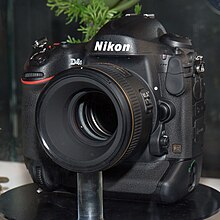
Nikon D4S full-frame (FX) digital SLR camera
Currently DSLRs are widely used by consumers and professional still photographers. Well established DSLRs currently offer a larger variety of dedicated lenses and other photography equipment. Mainstream DSLRs (in full-frame or smaller image sensor format) are produced by Canon, Nikon, Pentax, and Sigma. Pentax, Phase One, Hasselblad, and Mamiya Leaf produce expensive, high-end medium-format DSLRs, including some with removable sensor backs. Contax, Fujifilm, Kodak, Panasonic, Olympus, Samsungpreviously produced DSLRs, but now either offer non-DSLR systems or have left the camera market entirely. Konica Minolta's line of DSLRs was purchased by Sony.
  • Canon's current 2018 EOS digital line includes the Canon EOS 1300D/Rebel T6, 200D/SL2, 800D/T7i, 77D, 80D, 7D Mark II, 6D Mark II, 5D Mark IV, 5Ds and 5Ds R and the 1D X Mark II. All Canon DSLRs with three- and four-digit model numbers, as well as the 7D Mark II, have APS-C sensors. The 6D, 5D series, and 1D X are full-frame. As of 2018, all current Canon DSLRs use CMOS sensors.
  • Nikon has a broad line of DSLRs, most in direct competition with Canon's offerings, including the D3400, D5600, D7500 and D500 with APS-C sensors, and the D610, D750, D850, D5, D3X and the Df with full-frame sensors.
  • Leica produces the S2, a medium format DSLR.
  • Pentax currently offers the K-3 II, K-S2 and K-S1, all of which use an APS-C sensor.These models offer extensive backwards compatibility, accepting all Pentax K mount lenses, which started being made in 1975. Pentax also offers the Pentax 645Z, which is a medium format camera, and, like Pentax' medium format film cameras, compatible with Pentax' 645 system lenses. In 2016, Pentax introduced its first full-frame DSLR, the Pentax K-1, with the successor K-1 Mark II announced in 2018.
  • Sigma produces DSLRs using the Foveon X3 sensor, rather than the conventional Bayer sensor. This is claimed to give higher colour resolution, although headline pixel counts are lower than conventional Bayer-sensor cameras. It currently offers the entry-level SD15 and the professional SD1. Sigma is the only DSLR manufacturer which sells lenses for other brands' lens mounts.
  • Sony has modified the DSLR formula in favor of single-lens translucent (SLT) cameras,which are still technically DSLRs, but feature a fixed mirror that allows most light through to the sensor while reflecting some light to the autofocus sensor. Sony's SLTs feature full-time phase detection autofocusduring video recording as well as continuous shooting of up to 12 frame/s. The α series, whether traditional SLRs or SLTs, offers in-body sensor-shift image stabilization and retains the Minolta AF lens mount. As of July 2017, the lineup included the Alpha 68, the semipro Alpha 77 II, and the professional full-frame Alpha 99 II. The translucent (transmissive) fixed mirror allows 70 percent of the light to pass through onto the imaging sensor, meaning a 1/3rd stop loss light, but the rest of this light is continuously reflected onto the camera's phase detection AF sensor for fast autofocus for both the viewfinder and live view on the rear screen, even during video and continuous shooting. The reduced number of moving parts also makes for faster shooting speeds for its class. This arrangement means that the SLT cameras use an electronic viewfinder as opposed to an optical viewfinder, which some consider a disadvantage, but does have the advantage of a live preview of the shot with current settings, anything displayed on the rear screen is displayed on the viewfinder, and handles bright situations well.

Thank you for reading my blog...............
;-)            :-)            😊😊☺️☺️☺️☺️

Thursday, June 20, 2019

Scams of india part 2

Contd.......

Remain scam they are listed below.

17. NRHM scam:-
The National Rural Health Mission more commonly known as NRHM is a central government
program designed to refine and boost the health care delivery which was concentrated in the
rural areas. Soon this National Rural Health Mission program came up to be a corruption
scandal in the state of Uttar Pradesh.

18. Ketan parekh scam:-
Ketan Parekh, a trainee of Harshad Mehta from Mumbai was a former stock broker who was
declared to be guilty of a criminal offence by the verdict of the jury for he played a major
manipulative role in the Indian stock market scam which took place between 1999- 2001.
However now he has been barred from trading in the Indian stock exchanges till 2017.

19. Narendra nastogi scam:-
Viren Rastogi an influential UK based businessman and his group of brothers all major
businessmen in the field of metal trading globally were charge sheeted for fraudulent
activities and duping nearly 20 banks including West LB, JP Morgan Chase and Dresdner
Bank. This also includes banks in India.

20. Public distribution scam :-
The former Chief Minister of Arunachal Pradesh Gegong Apang is reportedly accused for his
involvement in the Rs 1,000-crore public distribution system scandal and was placed in police
custody for a period of seven days. At the time of Gegong Apang arrest he was 61 year old
and he was charged on various grounds like for cheating and forgery under IPC.

21. Railgate scam:-
The Railgate scam reveals the fact that Vijay Singla nephew of former Railway Minister Pawan
Kumar Bansal was charged and arrested by the Central Bureau of Investigation officers for
apparently accepting illegal money or bribery of RS 90 lakh from a member of the Railway
Board.

22. Stayam scam:-
The scam caused by the Satyam Computer Services Limited, leading IT company of India is
one among the biggest scandals of a corporate firm in India which caused a huge loss to the
investors of about nearly Rs.14, 162 crores. Ramalinga Raju the Chief Executive Officer of
Satyam computers is the main accused in the scandal.

23. Saradha group scam:-
IA Kolkata based Saradha group of companies whose chief is Sudipta Sen has been
reportedly accused for its multi crores chit fund scam where it has cheated its lakh of
investors both poor and rich. Saradha group has more than 150 firms registered with the ROC
(Registrar of Companies) and deal with a number of business like real estate, automobile,
education and entertainment.

24. Scorpene scam:-
The Scorpene submarine scandal is once again a black mark to India which involves a bribery
of about Rs. 500 crores which has been reportedly said to be paid to the deciding authorities
of the government by Thales, a French based company who were the makers of the Scorpene
submarine.

25. Snc lavalin scam:-
This is a financial scandal involving the Indian Government and the Canadian Company SNC
Lavalin. This was a formal business between the Canadian Company SNC Lavalin with the
Indian government reporting a net loss of 3745.0 million to the exchequer. This business
dealing was about the renovation and upgrading work of the hydro electric power stations at
Pallivasal (37.5 mW), Sengulam (48 mW) and Panniar (30 mW).

26. State bank scam:-
State Bank of Saurashtra scam is nearly seven month old scam which happened in the year
2008. State bank of Saurashtra was one of the connect bank of the SBI. It was in the year
1902 that the State bank of Saurashtra was started as Bhavnagar Darbar Bank. Bhavnnagar isone of the sovereign entity or princely states of the Saurashtra region of Gujarat.

27. Solar panel scam:-
The popular Kerala Solar panel scam which took place in 2013 is another black mark to India.
The Kerala solar panel scam was about swindling of a huge amount of money by an illicit
solar energy company named Team Solar located in the state of Kerala in India. This scandal
involved mainly two women who very conveniently established contacts.

28. Tatra truck scam:-
Tatra Trucks is another scam listed in the history of Independent India. The charge filed in the
Tatra trucks scam is against some of the top officials of the Bharat Earth Movers Ltd (BEML)
which is a defence public undertaking. Bharat Earth Movers Ltd ( BEML ) a Bengaluru-based
public sector company that has a collaboration with Tatra Vectra Motors Ltd .

29. Telgi scam:-
Abdul Karim Telgi from Belgaum in Karnataka is the main accused in the major Telgi scam
which is worth more than 43,000 crores. The scam involved the printing and circulation of
duplicate stamps and stamp papers. The Telgi scam also involves senior police officials and
politicians who have aided Abdul Karim Telgi develop this multi crores business.

30. 2G spectrum scam:-
This is one among the biggest scam in the history of political India which involved politicians
and government officials against law undercharging mobile telephone companies for
frequency allocation licenses, which they would then use to create 2G spectrum subscriptions
for cell phones.

31. Urea scam:-
P.V. Prabhakar Rao, the youngest son of former Prime Minister P.V. Narasimha Rao has
caused a major public disgrace or shame and especially at the time of his father's rise in the
political career. The Enforcement department was however looking for the right evidence to
file a charge sheet against him and was hunting for P.V. Prabhakar Rao for his illegal
involvement in the Rs.133 crores urea scam in 1995.

32. UTI scam:-
The Unit Scheme of 1964 which is more commonly referred in terms of US-64 of the Unit
Trust of India faced and the investors of this cadre faced a major jolt in the year 1998 when
they came to known certain issues through the media reports stating that things were
seriously wrong with the mutual fund major. The US-64 scheme which was extremely doing
good suddenly noticed depleting funds and vindication which was exceeding the sales.

Thank you for reading my blog.........

Scams of India part 1

              There are many scams in India some of them are listed below.

1. Adarsh housing socity1 scam:-
The Adarsh Housing Society is situated in
Colaba, Mumbai and it is a 31 storey
building constructed in a prime real estate
location. The Adarsh Housing Society was
mainly constructed for the welfare of war
widows and personnel of India's Ministry of
Defence.

2. Bellary mining scam:-
The Bellary mining scandal involved the three mining baron brothers from Karnataka. The
Bellary mining also led to the resignation of the then chief minister B S Yeddyurappa who was
responsible for a loss of about Rs16, 085 crores for the state government.

3. Bhansali scam:-
Bhansali scam took place in the year 1995 which is worth Rs 1,200 crores and the key person
involved in this businessman was Chain Roop Bhansali. Between the periods of 1992 - 1996
Chain Roop Bhansali was running a lot of financial firms.

4. Bofors scandal:-
The Bofors scandal is supposed to be stamping on the Indian Political corruption. The
scandal is all about when the Indian Defense Ministry had to buy Howitzers for its army's
artillery units in March 1986 from AB Bofors, Swedish manufacturer.

5. Cash for vote scam:-
The cash for vote scandal is once again a major scandal in the history of independent India
which involved the then majority-holding parliamentary-party alliance of India headed by Sonia
Gandhi and the United Progressive Alliance supposed to have bribed the member of
Parliaments of the Bharathiya Janata Party.

6. Chopper scam:-
One of the latest scam in India is the Chopper scandal which is better known as Choppergate.
The Chopper scam is all about the politicians and the defence officers against whom charge
sheets have been filed for accepting illegal money from Augusta Westland in clearing an
agreement.

7. Coal allocation scam:-
The Indian coal allocation scam more popularly known through the media as Coalgate is one
of the major controversy in the year 2012 which has led to the consequence of extensive
torment among not only the people but also among the anti-corruption protesters.

8.Cobbler scam:-
One of the biggest scams that have happened in the Indian history is the cobbler scam which
involves money worth several multi million dollars. This was most popularly discussed as theGreat Cobber scam.

9. Commom wealth scam:-
The Commonwealth Games scam conducted in the year 2010 in New Delhi is one of the most
well known scam of India whose main accused being Suresh Kalmadi, the chairman of the
Organizing Committee of the Commonwealth Games. The Commonwealth scam involves a
pilferage of about nearly Rs 70,000 crores.

10. Dalmia scandal:-
One of the top performers in the field of software and IT services was DSQ Software Ltd, in
Chennai India was established in the year 1992. Initially when the company was established it
was known as Square D Software Ltd but later as it got graduated in its field the company
changed its name in the year 1997 to DSQ Software.

11. Fodder scam:-
The fodder scam broke out in 1996 and it involved the apparent misappropriation of nearly Rs
950 crores from the treasury of Bihar government. The fodder scam involves big heads
mostly the government officials of the Bihar State Government and also a number of elected
officials of various administrative departments of Bihar state.

12. Granite scam:-
The granite scam which came to light in the year 2012 is one among the major scandals in
Madurai, in the state of Tamil Nadu. This scam involved the forbidden quarrying of granite in
the nearby area of Madurai district. The granite scam was exposed to the public when the
then collector of Madurai district sent a report on this illegal activity of quarrying to the Chief
Minister's office.

13. Harshad mehta scam:-
The name Harshad M Mehta was in the focus of public attention in the year 1992 with a number of financial crimes charged on him. Harshad Mehta was an Indian Stock broker who
was purported for a huge stock deployed scheme bankrolled by insignificant bank receipts,
which his company negotiated in ready forward transactions between banks.

14. Hawala scam:-
The Hawala scandal or the scam was all about Indian political scandal which involved money
reportedly got by some powerful political figures and bureaucrats, between February 1988,
and April 1991 through Hawala agents namely, 4 Jain brothers the main person being involved
one Surindra Kumar Jain .

15. ISRO spectrum allocation scam:-
One scam in the series is the Indian Space Research Organization's which was kept under the
hat for nearly 6 years and only later hatched out its secret. ISRO spectrum allocation scam
involves the process of allocating the S-band spectrum by ISRO-arm Antrix.

16. Indian airforce scam:-
Another scam which hit the history of Indian defense department which came into public
notice in 2012 when the then defense minister A.K. Antony for an investigation into the scam
by the Central Bureau of Investigation. The defense minister A. K. Antony ordered to probe
into the reported bribery in a deal worth thousands of crores.

To be continued ...........

Thank you for reading my blog............:-):-):-D

Tuesday, June 18, 2019

What knowledge you should have to be in government jobs in india

      Education and knowledge are  the most important factor to get government jobs un India.
According to me 10th is min qualification to get peon job. As the qualification increase the salary as well as rank in the post increase.
        We have to pass puc/12th to get post D in government jobs. There are manys jobs in India for those who are undergraduate and graduates.
Along that we can get knowledge about computer and computer languages, typing,using excel etc.  Along we can be physical fit to join defence and police to serve the nation and the city.

What are the bitter turths of accenture employees of india

In June 2012 there were coming in a surprising number of positive employee reviews about Accenture on career web sites.

It was surprising because Accenture is having problems with employee satisfaction and employee turn-over. Because of these problems it needs to recruit massive amounts of employees each year. Therefore, online reviews are very important to Accenture.
     
          When we noticed the sudden increase of online reviews we immediate thought that Accenture’s HR department had been “encouraging” its employees to write positive reviews online.

In addition, many of the reviews were strangely positive. The titles were “Great Place to Work” and variations of that.

“Amazing place to work.”

“Awesome place to work.”It was not only the increased number of reviews that made us suspicious. We were also surprised to see how many of the reviews were positive.
             Curiously, many of the reviews mentioned the exact phrase “Great Place to Work” or variations thereof, such as “awesome place to work”, in the reviews.

Could it be that the HR personnel sent out emails ordering employees to say that Accenture is a great place to work, and some of these employees failed to rephrase it in their own words

This is what we first thought: that HR was asking employees for positive reviews, but as pointed out by one of our readers in the comment section below, it is much more likely that someone in HR is just writing all of these positive reviews.

This would be quite easy: just write a review, clear the cookies from your web browser (and perhaps change your IP address) then write the next review about how wonderful Accenture is, and so on.

That is likely why the language in the reviews was similar – it was the same person writing them!

It is difficult to tell that– about 16% of the reviews during the mention the phrase “great place to work” or something very similar, but it was common already before the (12%).

Looking into the reviews, we found out the following:

The amount of negative reviews didn’t change much, but the positive (and neutral) ones are up from an average of 73 reviews per month to 342 reviews in June.

During the peak in June, 75% of reviews were positive, which can be compared to 50% during January to May. 94% were either positive or neutral  during the June.
           Finding The Source of These Overly Positive Reviews

We were also able to figure out where all these positive reviews came from:

Of the 362 total reviews in June, at least 211 came from India.

That is 58% of all reviews. Granted, India is an important country for Accenture, but normally there are only about 18 reviews per month (average Jan to May) from employees of Accenture India.Most of the reviews were posted as – supposedly – current employees in the lower levels of the company.


Saturday, June 15, 2019

Indian navy:The warriors of the sea

       The Indian Navy is the naval branch of the Indian Armed Forces. The President of India is the Supreme Commander of the Indian Navy. The Chief of Naval Staff, a four-star admiral, commands the navy.
       The Indian Navy traces its origins back to the East India Company's Marine which was founded in 1612 to protect British merchant shipping in the region. In 1793, the East India Company established its rule over eastern part of the Indian subcontinent i.e. Bengal, but it was not until 1830 that the colonial navy was titled as His Majesty's Indian Navy. When India became a republic in 1950, the Royal Indian Navy as it had been named since 1934 was renamed to Indian Navy.

The primary objective of the navy is to safeguard the nation's maritime borders, and in conjunction with other Armed Forces of the union, act to deter or defeat any threats or aggression against the territory, people or maritime interests of India, both in war and peace. Through joint exercises, goodwill visits and humanitarian missions, including disaster relief, Indian Navy promotes bilateral relations between nations.


As of July 2017, Indian Navy has 67,228 personnel in service and has a fleet of 137 battleships and 235 aircraft. As of March 2018, the operational fleet consists of one aircraft carrier, one amphibious transport dock, eight landing ship tanks, eleven destroyers, thirteen frigates, one nuclear-powered attack submarine, one ballistic missile submarine, fourteen conventionally-powered attack submarines, twenty-two corvettes, one mine countermeasure vessel, four fleet tankers and various other auxiliary vessels.

        The maritime history of India dates back to 6,000 years with the birth of art of the navigation and navigating during the Indus Valley Civilisation.A Kutch mariner's log book from 19th century recorded that the first tidal dock India has been built at Lothal around 2300 BC during the Indus Valley Civilisation, near the present day harbour of Mangrol on the Gujarat coast. The Rig Veda, credits Varuna, the Hindu god of water and the celestial ocean,with knowledge of the ocean routes and describes the use of ships having hundred oars in the naval expeditions by Indians. There are also references to the side wings of a ship called Plava, which stabilizes the vessel during storms. Plava is considered to be the precursor of modern-day stabilizers.The first use of mariner's compass, called as Matsya Yantra, was recorded in 4 and 5 AD.   

 Equipments:

ShipsEdit

The names of all in service ships and naval bases of the Indian Navy are prefixed with the letters INS, designating Indian Naval Ship or Indian Navy Station,whereas the sail boats are prefixed with INSV (Indian Naval Sailing Vessel).The fleet of the Indian Navy is a mixture of domestic built and foreign vessels, as of January 2018, the surface fleet comprises 1 aircraft carrier, 1 amphibious transport dock,8 Landing ship tanks,11 destroyers, 13 frigates,22 corvettes,10 large offshore patrol vessels, 4 fleet tankers,7 Survey ships, 1 research vessel,3 training vesselsand various auxiliary vessels, Landing Craft Utilityvessels, and small patrol boats.

After INS Viraat was decommissioned on 6 March 2017, the Navy is left with only one aircraft carrier in active service, INS Vikramaditya, which serves as the flagship of the fleet.Vikramaditya (formerly Admiral Gorshkov) is a modified Kiev-class aircraft carrierprocured at a total cost $2.3 billion from Russia in December 2013.The Navy has an amphibious transport dock of the Austin class, re-christened as INS Jalashwa in Indian service. It also maintains a fleet of landing ship tanks.

The navy currently operates three Kolkata, three Delhiand five Rajput-class guided-missile destroyers.The ships of the Rajput class will be replaced in the near future by the next-generation Visakhapatnam-class destroyers (Project 15B) which will feature a number of improvements.

In addition to destroyers, the navy operates several classes of frigates such as three Shivalik (Project 17 class) and six Talwar-class frigates. Seven additional Shivalik-class frigates (Project 17A class frigates) are on order. The older Godavari-class frigates will systematically be replaced one by one as the new classes of frigates are brought into service over the next decade.

Smaller littoral zone combatants in service are in the form of corvettes, of which the Indian Navy operates the Kamorta, Kora, Khukri, Veer and Abhay-classcorvettes.Replenishment tankers such as the Jyoti-class tanker, INS Aditya and the new Deepak-class fleet tanker- help improve the navy's endurance at sea.

SubmarinesEdit

INS Chakra, the nuclear attack submarine of the Indian Navy

As of December 2017, the Navy's sub-surface fleet includes one nuclear-powered attack submarine, one Ballistic missile submarine,14 conventionally-powered attack submarines.The conventional attack submarines of the Indian Navy consist of the Kalvari (French Scorpène-class submarine design), the Sindhughosh (Russian Kilo-class submarine design) and the Shishumar (German Type 209/1500 design) classes.

India also possesses a single Akula-class nuclear-powered attack submarine named INS Chakra. She is under lease to India for a period of ten years. Three hundred Indian Navy personnel were trained in Russia for the operation of these submarines.Negotiations are on with Russia for the lease of the second Akula-class submarine.

INS Arihant was launched on 26 July 2009 in Visakhapatnam, and was secretly commissioned into active service in August 2016.The Navy plans to have six nuclear-powered ballistic missile submarinesin service in the near future.Arihant is both the first boat of the Arihant-class nuclear-powered ballistic missile submarines and the first nuclear-powered submarine to be built in India.

Weapon systemsEdit

Gun firing trials of INS Kochi[164]
Barak 8 missile fired from INS Kolkata

The Navy use a mix of indigenously developed and foreign made missile systems. These include submarine-launched ballistic missiles, ship-launched ballistic missiles, cruise and anti-ship missiles, air-to-air missiles, surface-to-air missiles, torpedoes, air-to-air guns, main guns and anti-submarine rocket launchers. Its inventory comprises 100 mm (3.9 in) AK 190 gun with a range of 21.5 kilometres (13.4 mi), 130 kilometres (81 mi) KH-35E 4 Quad Uran, ASW RBU-2000 etc.

In the recent years BrahMos has been one of the most advanced missile system adapted by the India Navy. It has been jointly developed by India's Defence Research and Development Organisation (DRDO) and Russian NPO Mashinostroyeniya. BrahMos is the world's fastest anti-ship cruise missile in operation. The BrahMos has been tailored to meet Indian needs and features a large proportion of India-designed components and technology, including its fire control systems, transporter erector launchers, and its onboard navigational attack systems. The successful test of Brahmos from INS Rajput provides Indian Navy with precision land attack capability.

India has also fitted its Boeing P-8I reconnaissance aircraft with all-weather, active-radar-homing, over-the-horizon AGM-84L Harpoon Block II missiles and Mk 54All-Up-Round Lightweight Torpedoes.[168] Indian warships' primary air-defence shield is provided by Barak 1 surface-to-air missile while an advanced version Barak 8 is in development in collaboration with Israel.India's next-generation Scorpène-classsubmarines will be armed with Exocet anti-ship missilesystem. Among indigenous missiles, ship-launched version of Prithvi-II is called Dhanush, which has a range of 350 kilometres (220 mi) and can carry nuclear warheads.

The K-15 Sagarika (Oceanic) submarine-launched ballistic missile (SLBM), which has a range of at least 700 km (some sources claim 1000 km) forms part of India's nuclear triad and is extensively tested to be integrated with the Arihant class of nuclear submarines. A longer range submarine launched ballistic missile called K-4 is under testing, to be followed by K-5 SLBM.

Electronic warfare and systems managementEdit

Sangraha is a joint electronic warfare programme between Defence Research and Development Organisation (DRDO) and the Indian Navy. The programme is intended to develop a family of electronic warfare suites, for use on different naval platforms capable of detecting, intercepting, and classifying pulsed, carrier wave, pulse repetition frequency agile, frequency agile and chirp radars. The systems are suitable for deployment on various platforms like helicopters, vehicles, and ships. Certain platforms, along with ESM (Electronic Support Measures) capabilities, have ECM (Electronic Countermeasure) capabilities such as multiple-beam phased array jammers.

The Indian Navy also relies on information technology to face the challenges of the 21st century. The Indian Navy is implementing a new strategy to move from a platform centric force to a network centric force by linking all shore-based installations and ships via a high-speed data networks and satellite(s).This will help in increased operational awareness. The network is referred to as the Navy Enterprise Wide Network (NEWN). The Indian Navy has also provided training to all its personnel in Information Technology (IT) at the Naval Institute of Computer Applications (NICA) located in Mumbai. Information technology is also used to provide better training, like the usage of simulators and for better management of the force.

The Navy has a dedicated cadre for matters pertaining to information technology cadre named as Information Technology Cadre,under the Directorate of Information Technology (DRI). The cadre is responsible for implementation for enterprise wide networking and software development projects, development activities with respect to cyber security products, administration of shore and on-board networks, and management of critical Naval Networks and software applications.

Naval satelliteEdit

India's first exclusive defence satellite GSAT-7 was successfully launched by European space consortium Arianespace's rocket from Kourou spaceport in French Guiana in August 2013. GSAT-7 was fabricated by the Indian Space Research Organisation (ISRO) to serve for at least seven years in its orbital slot at 74°E, providing UHF, S-band, C-band and Ku-band relay capacity. Its Ku-band allows high-density data transmission, including both audio and video. This satellite also has a provision to reach smaller and mobile terminals.

GSAT-7 approximately has a footprint of 3,500–4,000 kilometres (2,200–2,500 miles; 1,900–2,200 nautical miles) over the Indian Ocean region, including both the Arabian Sea and the Bay of Bengal region. This enables the Navy to operate in a network-centric atmosphere having real-time networking of all its operational assets at sea and on land

1st Indian women to enter war

Hi friends,,,,,,,,,,,, Sorry for late, Not written for a long time sorry for that. Today i am going write the woman who can work in home be...